How to get backlinks for a small business
Of the nine reasons your site is missing from Google, links are the one you control least. Fix the other eight first, then claim the links you are owed.
Of the nine reasons your site is missing from Google, this is the one you control least and the one that takes longest. Fix the other eight first: a link cannot rescue a page that is blocked, noindexed, or pointing its canonical at a domain you disallowed. Then spend the following year collecting the ten to thirty links you are already entitled to and have never claimed. The methods that promise more, faster, are mostly the ones Google's link spam policies name outright: paying for links that pass ranking credit, trading goods or services for them, and mass guest posting without proper link tags.
What this actually is
A link from another site is the one signal on your page you did not write. Google's own framing, from the 2021 link spam update announcement: "Links are one of the ways Google understands what content may be helpful to searchers, and they can be good for sites to receive, as long as they're well deserved."
Links do two separate jobs, and the small one gets forgotten. The first job is discovery. The SEO Starter Guide says "the vast majority of the new pages Google finds every day are through links". If nobody links to you and your sitemap is thin, Google has to be told you exist. The second job is corroboration: somebody else vouched for this.
Now the part that gets misreported. Paying for a link is not itself against the rules. Google's position is that buying and selling links is a normal part of the economy of the web, and it becomes a policy violation only when a paid link is left unqualified and passes ranking credit. Qualify it with rel="sponsored" or rel="nofollow" and the sponsorship is legitimate, which is why a paid listing in a trade directory and a bought guest post are not the same transaction. Leave it unqualified and you are relying on a link Google's systems are built to catch: the 2021 announcement uses "nullifying" repeatedly for the link spam it identifies, and Google says sites that violate its policies may rank lower or not appear in results at all.
The reframe that matters for a small site: links are not a lever you pull, they are a byproduct of being a real business other real businesses have reason to mention. If your site is not indexed, links are irrelevant. If it is indexed and invisible, links are the slow half of the answer and content is the fast half.
How to check
Search Console, left navigation, bottom of the list: Links. Direct URL: https://search.google.com/search-console/links.
Three tables sit under External links:
- Top linked pages shows which of your pages have the most backlinks.
- Top linking sites shows which root domains link to you the most.
- Top linking text shows the anchor text other people used.
Click MORE under any table for the full list. Read the report's stated limits before you interpret anything:
- Tables are limited to 1,000 rows.
- It "isn't a comprehensive list of every link on your site". It is a sample.
- Data is grouped by root domain. Protocol, subdomain, and subdirectory are stripped, so www.example.com and m.example.com both appear as example.com.
- It "includes links that Google has found over time". Some of them no longer exist.
- It "doesn't specify if a link is marked as nofollow".
Export via Export external links, which gives you Latest links (most recently discovered, up to 100,000 rows) and More sample links, as CSV or Google Sheet.
Two checks the report will not do for you. To confirm a link still exists, open the linking page and use the browser's find function on your domain. For an indication of how the link is treated, view the page source and read the rel attribute on that anchor tag. Read it as a signal rather than a verdict: since 2019 Google has treated nofollow, ugc, and sponsored as hints, and says links carrying them will generally not be followed, so no attribute value tells you with certainty whether ranking credit passed.
Then open Manual actions in the same navigation. A green check mark means Google has taken no human action against you.
What you will see
Empty, or "No data available". Three causes. You have no external links, which for a new site is normal. The property was verified days ago and has no data yet. Or you are looking at the wrong property: a URL-prefix property for http://example.com/ excludes https:// and www.. Fix that with a Domain property, which covers all subdomains and protocols and verifies by DNS record only.
Only your own domains. Your social profiles, your old site, your booking widget's host. Treat that as zero.
Five to twenty recognisable sites. Your supplier, your trade body, the local paper. That is a working baseline, and it is more than most local businesses have.
Domains you have never heard of, often foreign-language, often scraped copies of your own text. Background noise on the open web. Google says it can usually assess which links to trust without your help. Leave them alone.
A manual action reading "Unnatural links to your site". Google's description: "a pattern of unnatural, artificial, deceptive, or manipulative links pointing to your site". Google's stated effect is that some or all of your site may not be shown in search results. This is the outcome you are trying not to buy.
How to fix
Claim what you are already entitled to
Work from physical evidence, not memory. Pull your supplier invoices, your insurance certificate, your trade licence, the logos on the van and the shop door, and the recurring memberships on your bank statement. Each of those organisations likely publishes a page you belong on:
- Manufacturer "where to buy" and dealer or installer locators
- Wholesaler and distributor stockist lists
- Trade association member directories
- Licensing or certification body registers
- Chamber of commerce member lists
- Franchise and buying-group directories
One email each. Include: business name spelled exactly as it appears everywhere else, full address, phone number, the full URL with https:// and the trailing slash, one sentence of description, and your membership or account number so they can find you in their system. Ask for the link to point at your homepage, not at a PDF.
Sponsorships, with one rule
The under-11s kit, the village hall roof, the school raffle, the coffee break at a regional trade day. These organisations publish sponsor pages. The rule: sponsor things you would sponsor anyway, and let them decide whether to link. Buying a sponsorship for the ranking credit is "exchanging money for links", the first item on Google's link spam list. The fix is one attribute, not abstinence: tell them rel="sponsored" is fine and the sponsorship stays inside the rules. You still get the sign, the traffic, and the name in front of the right town.
Customers, partners, and suppliers
Write the case study yourself. Do the work, take the photos, hand over the finished asset, and ask whether they would like to publish it. Manufacturers want testimonials and testimonial pages link back to the business that gave them.
Local and trade press
What makes a story: a number nobody else has, a first, an anniversary with a photograph, a hire, an unusual job. The email that gets used: subject line written as the headline you want them to run, three sentences of what happened, one sentence of who you are, the photo attached at full resolution with a caption naming everyone left to right, and your mobile number. No template, no "please find attached our press release".
Some outlets mark every outbound link nofollow. Take the coverage anyway. Their readers are your customers.
Publish something worth citing
Turn the question around. Not "who will link to me" but "what would someone have to cite". For a small business that usually means the thing you know and nobody has written down: a transparent price page, a specification comparison table, the local regulatory checklist, or a number out of your own job records. Google's self-assessment question is the test: "Is this the sort of page you'd want to bookmark, share with a friend, or recommend?"
What is covered by the link spam policies
Google's list covers link exchanges intended to manipulate ranking, and it names these outright: exchanging money for links, exchanging goods or services for links, sending someone a product in exchange for a link, excessive link exchanges, partner pages that exist only for cross-linking, low-quality directory or bookmark links, links in widgets distributed across sites, and "advertorials or native advertising where payment is received for articles that include links that pass ranking credit". On guest posting the 2021 announcement is specific: "excessive sponsored and guest posting without proper link tags" can draw both algorithmic and manual actions.
The stated consequence, verbatim: "Sites that violate our policies may rank lower in results or not appear in results at all." Detection is by automated systems and, as needed, human review that can result in a manual action. Reconsideration reviews take days or weeks, and Google notes link-related requests "may take longer than usual".
Paid links themselves are not the violation. Google says buying and selling links is "a normal part of the economy of the web", and it is not a policy violation as long as the links are qualified.
The qualifier attributes
These apply to links leaving your site. You cannot set them on links coming in.
- rel="sponsored" for advertisements, paid placements, and affiliate links. Preferred over nofollow for this case.
- rel="ugc" for user-generated content: comments and forum posts. You may remove it for contributors who have earned trust over time.
- rel="nofollow" when the other two do not apply and you would rather Google not associate your site with, or crawl to, the linked page.
Multiple values are legal, space- or comma-separated: rel="ugc nofollow". These attributes are for links Google can crawl. To stop Google fetching a page on your own site use a robots.txt disallow rule; to keep a page out of the index, allow crawling and use noindex.
Disavow: almost certainly not you
Google's own Step 0: "In most cases, Google can assess which links to trust without additional guidance, so most sites will not need to use this tool." And the warning above it: "This is an advanced feature and should only be used with caution. If used incorrectly, this feature can potentially harm your site's performance in Google Search results."
Both conditions must hold before you touch it: a considerable number of spammy, artificial, or low-quality links, and those links have caused a manual action or are about to. A site with four scraper mirrors and a green check on the Manual actions report meets neither. The tool also does not support Domain properties, uploading a new list replaces the old one entirely, and changes take a few weeks to be reprocessed. The realistic failure mode for a small site is disavowing the one good link it had.
What it costs
The entitlement audit takes two to three hours to assemble from invoices and statements, then ten to twenty minutes per organisation to write and send. Fifteen organisations is roughly one working day spread across a week.
Replies: a few within the week, most in two to six weeks, several never. Directory listings often wait for whenever that organisation next updates its site, which can be a quarter.
After the link goes live, Google still has to recrawl the linking page. No fixed schedule, and no way to request it, because you do not own the page.
The effect is not isolatable. You will not see a step change from fifteen links, and nobody can honestly tell you what your rankings will do. What you can measure: the Links report moving from zero to fifteen named domains, and referral sessions arriving in analytics from pages you can point at.
A realistic year-one yield for a small local business is ten to thirty links, mostly directories and memberships, with one or two press mentions. Anyone offering two hundred in a month is selling volume of the kind of link Google says its systems nullify.
This is the slowest of the nine repairs. It cannot be hurried without taking on risk, and the risk is asymmetric: months of patient work against a manual action. What Google says a manual action does is make pages or sites rank lower or be omitted from results, and some actions apply to only part of a site rather than all of it. Even the partial version costs you more than the shortcut saved.
Not sure which of the nine is actually holding your site back? Run the free web audit.
References
Spam policies for Google web search - Google Search CentralQualify your outbound links to Google - Google Search CentralSEO Starter Guide: the basics - Google Search CentralCreating helpful, reliable, people-first content - Google Search CentralA reminder on qualifying links and our link spam update - Google Search Central BlogEvolving "nofollow": new ways to identify the nature of links - Google Search Central BlogLinks report - Google Search Console HelpManual actions report - Google Search Console HelpDisavow links to your site - Google Search Console HelpAdd a website or platform property to Search Console - Google Search Console HelpBy Jesper Jurcenoks
Next in the series
How to fix a website that breaks on a phone
Your desktop rankings are computed from the phone rendering. Google indexes with Googlebot Smartphone, so what a phone cannot reach is not indexable.
2026-08-18
Google picked a different version of your page: fixing duplicate URLs and canonicals
Your page is indexed. Google just indexed a different URL of it than the one you promote and track. Pick one form, redirect the rest, make the signals agree.
2026-08-18
How to find and remove a noindex tag or robots.txt block that keeps your site out of Google
Your site is not missing from Google. It is being refused, on your own instruction. Three mechanisms can issue it, and two leave nothing in your HTML.
2026-08-18
Only your homepage is indexed: how to get Google to find the rest of your site
Google indexes what it can reach. If only your homepage is indexed, your pages are not being outranked: they are not being found. Internal links come first.
2026-08-18How to get backlinks for a small business
Of the nine reasons your site is missing from Google, links are the one you control least. Fix the other eight first, then claim the links you are owed.
2026-08-18
How to get Google to index a new website
If your site went live in the last few weeks, the likely explanation is the boring one: Google has not got to you yet. What shortens the wait, and what does not.
2026-08-18
How to make your website faster and pass Core Web Vitals
Compressing your images will not fix this. Three numbers decide whether Google calls your site fast, and two are set by your architecture, not your assets.
2026-08-18
How to show up in local Google search when you serve a town
Your website is not your entry on the map. The map pack is fed by a Google Business Profile, a separate record you must claim and verify to compete on it.
2026-08-18
My page is indexed but gets no traffic: how to make it answer the question
Your page is not missing from Google. It is present and unwanted. Search Console tells you which problem you have: not being shown, or shown and not chosen.
2026-08-18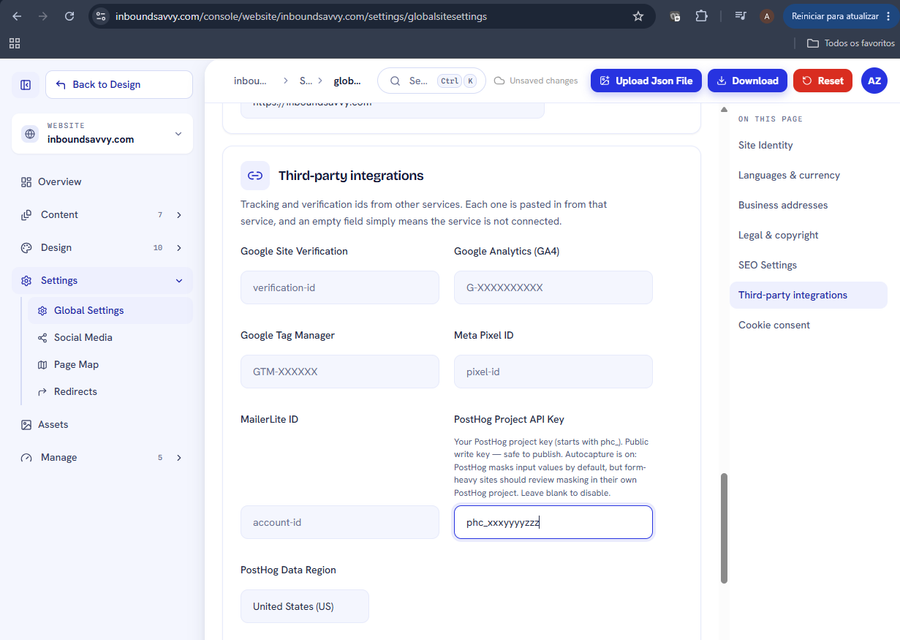
Set Up PostHog Analytics for Your Website
PostHog shows what visitors actually do on your site. InboundSavvy has it built in: one token, one dropdown. Includes how to connect PostHog's MCP server so your AI assistant can query the data.
2026-08-05
How to Get Your Small Business Found on Google in 2026
Getting found on Google changed with AI Overviews and AI Mode. Here's what actually moves the needle for a small business in 2026 - in plain English, no jargon.
2026-07-01
Why Isn't My Website Showing Up on Google? (9 Reasons + Fixes)
Nine reasons a small-business site does not appear in Google, each with the exact check that identifies it and the actual repair. Including what Search Console and Lighthouse each tell you, and why they disagree.
2026-06-28
The Small-Business Website SEO Checklist for 2026
SEO for a small business comes down to a handful of things done well. Here's a practical 2026 checklist, grouped by what each item actually does for you.
2026-06-25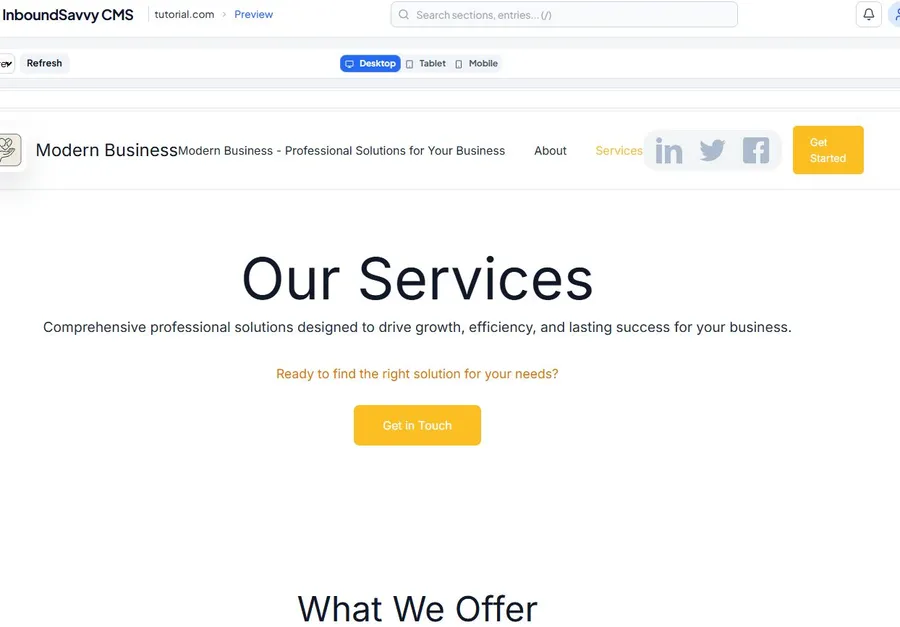
Let Claude Edit Your Website: Connecting InboundSavvy to Claude Code
A non-technical guide to setting up InboundSavvy's MCP integration with Claude Code - one prompt, a few clicks, and AI starts building your website.
2026-05-25Other articles
How to fix a website that breaks on a phone
Your desktop rankings are computed from the phone rendering. Google indexes with Googlebot Smartphone, so what a phone cannot reach is not indexable.
2026-08-18Google picked a different version of your page: fixing duplicate URLs and canonicals
Your page is indexed. Google just indexed a different URL of it than the one you promote and track. Pick one form, redirect the rest, make the signals agree.
2026-08-18How to find and remove a noindex tag or robots.txt block that keeps your site out of Google
Your site is not missing from Google. It is being refused, on your own instruction. Three mechanisms can issue it, and two leave nothing in your HTML.
2026-08-18Only your homepage is indexed: how to get Google to find the rest of your site
Google indexes what it can reach. If only your homepage is indexed, your pages are not being outranked: they are not being found. Internal links come first.
2026-08-18How to get backlinks for a small business
Of the nine reasons your site is missing from Google, links are the one you control least. Fix the other eight first, then claim the links you are owed.
2026-08-18How to get Google to index a new website
If your site went live in the last few weeks, the likely explanation is the boring one: Google has not got to you yet. What shortens the wait, and what does not.
2026-08-18How to make your website faster and pass Core Web Vitals
Compressing your images will not fix this. Three numbers decide whether Google calls your site fast, and two are set by your architecture, not your assets.
2026-08-18How to show up in local Google search when you serve a town
Your website is not your entry on the map. The map pack is fed by a Google Business Profile, a separate record you must claim and verify to compete on it.
2026-08-18My page is indexed but gets no traffic: how to make it answer the question
Your page is not missing from Google. It is present and unwanted. Search Console tells you which problem you have: not being shown, or shown and not chosen.
2026-08-18Set Up PostHog Analytics for Your Website
PostHog shows what visitors actually do on your site. InboundSavvy has it built in: one token, one dropdown. Includes how to connect PostHog's MCP server so your AI assistant can query the data.
2026-08-05How to Get Your Small Business Found on Google in 2026
Getting found on Google changed with AI Overviews and AI Mode. Here's what actually moves the needle for a small business in 2026 - in plain English, no jargon.
2026-07-01Why Isn't My Website Showing Up on Google? (9 Reasons + Fixes)
Nine reasons a small-business site does not appear in Google, each with the exact check that identifies it and the actual repair. Including what Search Console and Lighthouse each tell you, and why they disagree.
2026-06-28The Small-Business Website SEO Checklist for 2026
SEO for a small business comes down to a handful of things done well. Here's a practical 2026 checklist, grouped by what each item actually does for you.
2026-06-25Let Claude Edit Your Website: Connecting InboundSavvy to Claude Code
A non-technical guide to setting up InboundSavvy's MCP integration with Claude Code - one prompt, a few clicks, and AI starts building your website.
2026-05-25